
Recruiter guide / industry insight17 Apr 2026
The roles recruiters secretly love working on
A light, insider look at the kinds of roles recruiters genuinely enjoy working on, and why those searches usually attract better candidates and move faster.
Practical hiring guide
Slow hiring does more than delay a decision. It creates doubt, weakens candidate confidence and increases dropoff. Here’s why good candidates leave slow processes, and how to fix it.
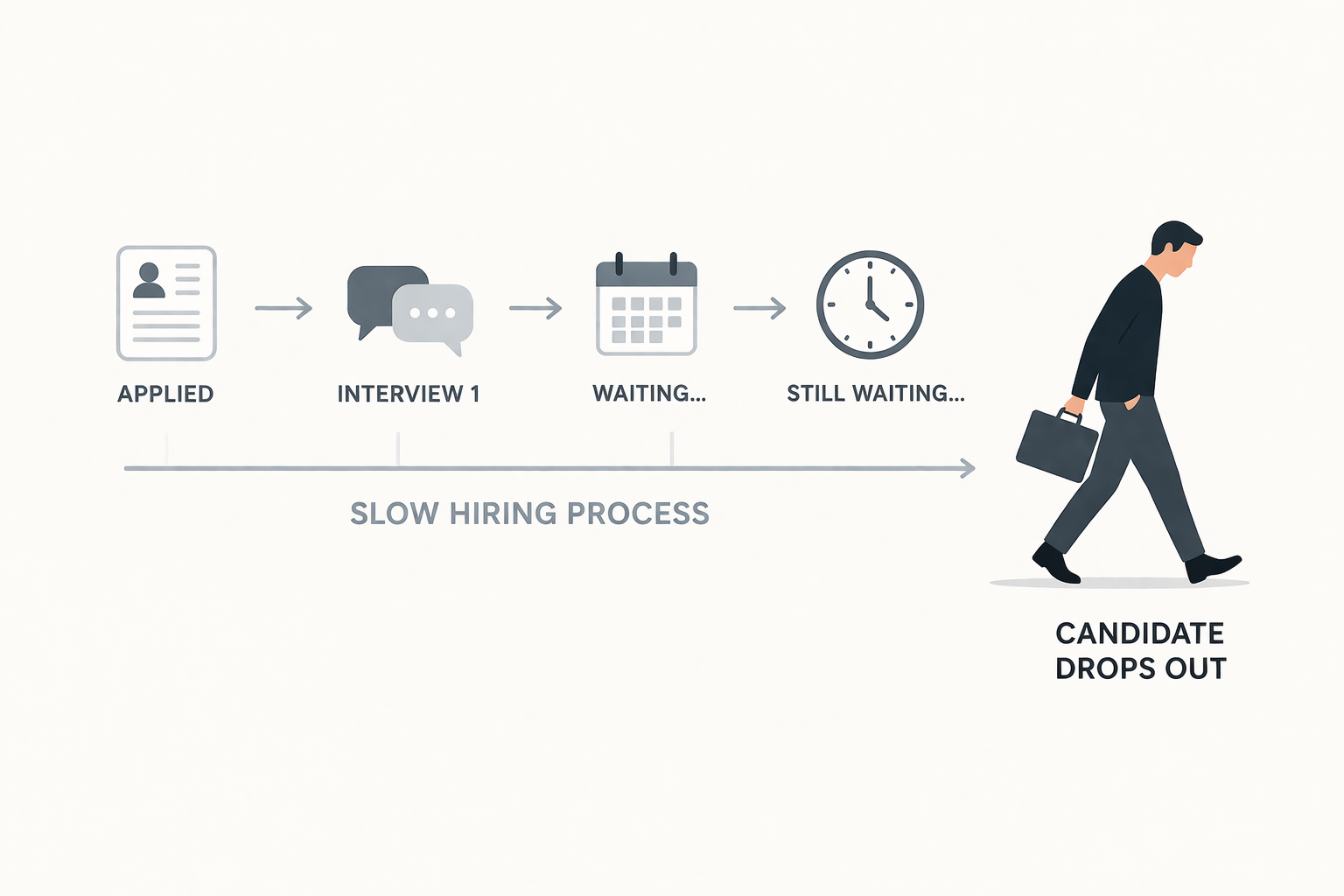
It usually happens in smaller ways. A brief is not fully aligned, so an extra screening call gets added. An interviewer is away, so the panel slips by a week. Feedback comes in late, so nobody wants to update the candidate until there is a final view. By the time the company is ready to move, the best candidate has gone quiet.
That is what makes this such a useful topic. Slow hiring is rarely just about speed. It is about confidence. A long or messy process tells candidates something about how decisions are made inside the company. Even when the role is strong, the process can introduce enough doubt to push good people away.
Candidates expect recruitment to involve assessment. That is not the issue. The problem starts when the process becomes unclear or inconsistent. If a candidate does not know how many rounds there are, when decisions will be made, or why the process has changed, they begin filling in the gaps themselves. Usually, they do not fill them in positively.
Employers should tell candidates how the process will work, how many interview rounds are likely, whether tasks are involved, when decisions will be made, and how soon they should expect to hear back. That matters because uncertainty is not neutral. It changes how a candidate experiences the role and the employer.
A delayed process often sends one of three signals. The company is unsure what it wants. The internal stakeholders are not aligned. Or the role is not genuinely important enough to move on. Sometimes none of those things are true. But that is often how it feels from the outside.
Speed is not just operational hygiene. It is part of the candidate experience.
This is one reason slow hiring gets underestimated. The drop-off does not always look dramatic. Candidates rarely send a formal note saying, “Your process made me lose confidence.” More often they become harder to pin down. Replies slow. Energy changes. Another offer appears. Or they stay polite while mentally checking out.
That matters because many hiring teams misread what happened. They tell themselves the candidate got a better salary elsewhere or simply changed priorities. Sometimes that is true. But quite often the process helped create that outcome.
There is another problem here. When a process drags, the quality of assessment can slip too. Interviewers lose continuity. Earlier impressions become harder to compare. Momentum disappears. Candidates become less natural and more cautious. A messy process does not just reduce acceptance rates. It can also make it harder to judge people well.
This is the useful reframing for readers. Slow hiring is usually not a discipline problem. It is a design problem.
The process is often doing too many jobs at once. It is trying to align stakeholders, reduce risk, gather evidence, compare edge cases and keep options open. That sounds sensible, but in practice it leads to bloated interview journeys and vague ownership. One extra stage gets added because no one wants to make the call yet. Another interviewer is included because someone senior wants visibility. Before long, the process is no longer testing fit. It is compensating for internal uncertainty.
The lesson is simple: structure matters, but unnecessary complexity does not make hiring more rigorous.
Many companies focus on how interviews are run and ignore the dead space around them. But that is often where candidate confidence is won or lost. A strong interview followed by eight days of silence still feels like a weak process. A good brief followed by shifting expectations still feels unstable.
Candidates do not need perfection. They need clarity.
This is worth saying because some readers will instinctively push back. Nobody wants a process that feels rushed or undercooked. The goal is not to move recklessly. The goal is to remove friction that does not improve decision quality.
A well-run process can still be thoughtful. It can still include structured interviews, a relevant task, and proper stakeholder input. The difference is that every stage has a clear purpose, the timeline is visible, and somebody owns momentum from start to finish.
They are judging how the company works.
If scheduling is chaotic, feedback is inconsistent, or the brief seems to move every week, candidates notice. They may never say it directly, but they are learning what it might feel like to work there. That is why hiring process quality matters beyond recruitment alone. It becomes a signal of management quality, team clarity and organisational confidence.
Strong candidates do not drop out only because competitors move faster. They drop out because slow hiring changes how the opportunity feels. Delay creates ambiguity. Ambiguity creates doubt. And doubt lowers trust.
That is why this is not really a post about speed in isolation. It is a post about process design. A good hiring process gives candidates enough clarity to stay engaged and gives the company enough structure to make a decision without constantly reopening the brief. When that balance is missing, even attractive roles can lose momentum.
For NOMORE:AGENCY, that is a useful and natural argument. It avoids generic “hire faster” advice and gets to the more interesting point: companies often lose candidates because the process was not designed to help people decide with confidence. Better hiring support should reduce that friction, not add to it.
Start by making the process visible. Tell candidates how many stages there are, what each one is for, whether any task is involved, and when decisions are likely to happen.
Then tighten ownership. One person should be responsible for keeping the process moving, collecting feedback quickly and updating the candidate even when there is no final answer yet.
Finally, cut stages that do not change the decision. If a round exists only because the team is not aligned, that is an internal problem disguised as assessment. Structured selection matters, but extra friction is not the same as rigour.
A slow hiring process does not just waste time. It changes how the role, the team and the company are perceived.
That is why good candidates drop out. Not always because another employer offered more, and not always because they were never serious. Often they leave because the process made the opportunity feel less certain, less important or less well run.
For employers, that is the real fix. Not simply moving faster for the sake of it, but designing a process that is clear, deliberate and easy for good candidates to stay in.
If candidates keep dropping out late in the process, it is worth looking beyond sourcing and back at how the process itself is built. Often the leak is not at the top of the funnel. It is in the gaps between stages.
Written by Brendan Woodage
Precision curation journal
Recommended reading
A few nearby essays from the same archive, chosen from other published posts.
A light, insider look at the kinds of roles recruiters genuinely enjoy working on, and why those searches usually attract better candidates and move faster.
Timetohire is one of the most tracked recruitment metrics. But when speed becomes the primary goal, hiring quality suffers. Here’s what the data says and what to measure instead.

UK employers are rethinking recruitment agency fees in 2026 as hiring slows, costs rise and traditional fee models face more scrutiny. Here is what has changed and what to review.