
Recruiter guide / industry insight17 Apr 2026
The roles recruiters secretly love working on
A light, insider look at the kinds of roles recruiters genuinely enjoy working on, and why those searches usually attract better candidates and move faster.
Company-focused / Hiring operations
Timetohire is one of the most tracked recruitment metrics. But when speed becomes the primary goal, hiring quality suffers. Here’s what the data says and what to measure instead.
A role goes live on Monday. By Friday, the hiring manager is already asking why they have not seen CVs.
In many companies, the unspoken rule is simple: faster is better. Recruiters are measured on time-to-hire. Agencies compete on speed of shortlist. Internal teams feel pressure to “move quickly before we lose the candidate.”
Speed feels productive. It feels decisive. It feels commercial.
But across the UK labour market, hiring has not become easier — despite this obsession with speed. According to the CIPD Resourcing and Talent Planning Survey (2023), 77% of employers reported hard-to-fill vacancies. The REC Recruitment Industry Trends Report (2024) continues to highlight persistent skill shortages across multiple sectors.
If speed alone solved hiring problems, we would not still be here.
The issue is not that time-to-hire is useless. The issue is what happens when it becomes the dominant measure of success.
Time-to-hire was designed as an efficiency metric. It helps organisations understand:
In operational terms, it is valuable. Vacancies carry cost. The CIPD (2023) notes that unfilled roles increase workload for existing staff and can negatively affect wellbeing and productivity.
Reducing unnecessary delay is sensible.
But over time, many organisations have shifted from using time-to-hire as a diagnostic measure to using it as a performance target.
That shift changes behaviour.
When recruiters — internal or agency — are judged primarily on speed, three predictable things happen:
This is not about competence. It is about incentives.
Agency models in particular are structurally aligned to speed. Most contingency recruitment fees are only paid on successful placement. That means revenue depends on filling the role before a competitor does. The commercial logic encourages rapid CV submission.
The result is velocity at the top of the funnel, not necessarily precision.
Hiring managers respond to urgency too.
When a vacancy has been open for weeks, the narrative shifts from “find the right person” to “we need someone in seat.”
This creates:
The irony is that rushed hiring often increases long-term instability.
The CIPD Good Work Index (2023) links poor job fit and weak onboarding to higher turnover and reduced engagement. While not directly a study of time-to-hire, it reinforces a broader truth: quality of alignment affects retention and performance.
Speed does not guarantee stability.
Time-to-hire is easy to measure. Quality of hire is not.
That imbalance creates distortion.
If a rushed hire leaves within 6–12 months, the role reopens. Agency fees may be paid again. Internal teams repeat the process.
The REC (2024) highlights continued reliance on agency hiring in tight labour markets, which compounds cost where repeat hiring occurs.
A slightly longer, more calibrated process can reduce rework.
Candidates experience rushed processes as transactional. Poor communication, compressed interviews and reactive offers damage perception.
The CIPD (2023) emphasises candidate experience as a critical factor in attracting scarce talent. Yet speed-focused environments often sacrifice experience for throughput.
Fast hiring often means shallow role scoping.
If success criteria are unclear at the start, the wrong person may be hired efficiently.
This is not a recruiter problem. It is a structural clarity problem.
The deeper issue is not time-to-hire itself. It is how hiring is commercially structured.
Traditional contingency agency models reward:
They do not reward:
Internal talent teams face similar distortions when measured heavily on vacancy closure metrics.
In both cases, the system incentivises movement over alignment.
Newer models — including networks of independent recruiters aligned to specific clients — attempt to rebalance this by prioritising fewer roles, deeper briefs and shared incentives. The structural shift matters more than the individual recruiter.
Hiring outcomes follow incentives.
Time-to-hire should remain visible — but not dominant.
Stronger complementary metrics include:
The CIPD (2023) continues to advocate for broader, more strategic talent metrics rather than purely transactional measures.
Speed is operational. Alignment is strategic.
Time-to-hire is not the enemy. Over-indexing on it is.
When speed becomes the primary success metric, it distorts recruiter incentives, compresses hiring rigour and increases long-term cost. The UK labour market data shows persistent hiring difficulty despite widespread KPI tracking. That suggests the issue is structural, not procedural.
Better hiring requires recalibrating what success looks like — and often, reconsidering the commercial models that underpin recruitment delivery.
Speed feels efficient. But efficiency without alignment is expensive.
The UK hiring market remains tight. Vacancies remain hard to fill. Tracking time-to-hire has not solved that.
The companies that consistently hire well are not necessarily the fastest. They are the clearest — about outcomes, expectations and incentives.
When hiring incentives change, behaviour changes.
And when behaviour changes, results follow.
If you are reviewing your hiring metrics this quarter, it may be worth asking a simple question: are we optimising for speed, or for fit?
Sometimes the difference between the two is where the real cost sits.
Written by Brendan Woodage
Precision curation journal
Recommended reading
A few nearby essays from the same archive, chosen from other published posts.
A light, insider look at the kinds of roles recruiters genuinely enjoy working on, and why those searches usually attract better candidates and move faster.
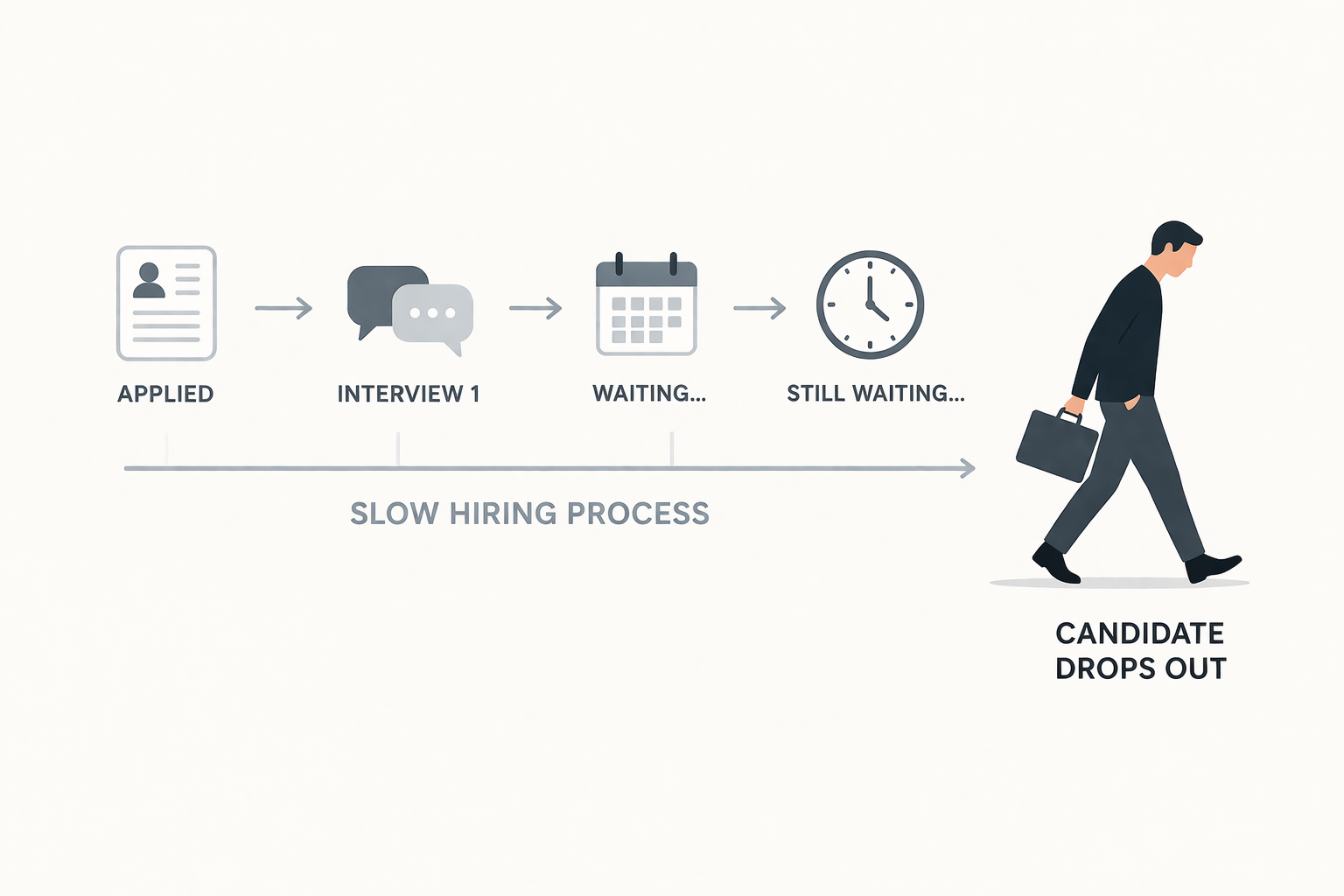
Slow hiring does more than delay a decision. It creates doubt, weakens candidate confidence and increases dropoff. Here’s why good candidates leave slow processes, and how to fix it.

UK employers are rethinking recruitment agency fees in 2026 as hiring slows, costs rise and traditional fee models face more scrutiny. Here is what has changed and what to review.